I thought that Morse enthusiasts might enjoy seeing a couple of Morse's creepy drawings for the "At the Ghost Hour" series. Happy Halloween!
Showing posts with label American decorated bindings. Show all posts
Sunday, October 23, 2016
Monday, February 2, 2015
Beside the Bonnie Brier Bush with Dust Jacket
Work on the Morse collection continues and I've been finding several binding variants and adaptations of known designs lately, although no new designs have shown up, with the exception of a speculation. I'll be getting the images and citations out soon. All of these are being added to the ACM collection, which I've been processing for the Watson Library. Although it has not been catalogued yet, if you are interested in seeing it, let me know.
Friday, October 24, 2014
The Metropolitan Museum of Art Acquires the Morse Collection
I have wonderful news to report. Thanks to the vision and support of Chief Librarian, Ken Soehner, my collection of books, archival materials and artifacts pertaining to my work on Alice C. Morse has recently been acquired by the Thomas J. Watson Library of The Metropolitan Museum of Art. As many of you know, the collection is a collection of record, created over a fifteen
year period, illustrating the life and work of one of the first and most
notable artist-designers of American decorated bindings, stained glass and
other decorative arts objects, throughout the last decade of the 19th
century. The collection was created for the purpose of bringing Morse’s work to
the public through my book The Proper
Decoration of Book Covers: The Life and Work of Alice C. Morse (New York:
Grolier Club, 2008) and to exhibit at the Grolier Club. It has grown substantially since then.
My Morse collection was made to compliment a group of 58 of Morse's own dummy book covers in the Museum's Department of Drawings and Prints. To see these, see the Museum's Timeline of Art History essay on Morse and search the Museum's online collections catalog.
Here is a link to the essay:
Here is a link to the Museum collections search page for Morse:
Through this blog and in blog posts on In Circulation, the Watson Library blog, I will continue to bring you updates on Morse's work and life. I will also continue searching for new designs by Morse and add them to the Museum's collection. The Morse collection has several components, all of which will now accessible to researchers in the Thomas J. Watson Library. The collection is not yet processed. For future reference, it includes the following groups of materials:
BOOKS
185 contemporary book with covers and
illustrations designed by Morse
These are books with covers and decorations known to have been designed by Morse. There are examples
of books featuring the first use of the designs and later binding variants and adaptations.
5 volumes that contain writings and
designs by Morse in their contents, some with covers designed by Morse
There
are 4 titles that have a Morse connection. They include Corticelli Home Needlework (1898), which includes needlework
designs by Morse; a two-volume copy of
House and Home (1894), that includes a chapter on “Occupations for Women”
that is illustrated by binding designs by Morse and Margaret Armstrong; and the Official
Handbook of the Woman’s Building from the World’s Columbian Exposition
(1893), with a chapter on “Women Illustrators” written by Morse.
18 books that may have been
designed by Morse or closely relate to her designs
These
are unsigned, unattributed bindings that have some connection to other books that Morse
designed. Some are in the style of Morse, and others are part of series for
which Morse is known to have designed covers. MORSE BIOGRAPHY AND CATALOG
The Proper Decoration of Book-Covers:
The Life and Work of Alice C. Morse, New
York: Grolier Club, 2008. (Blog readers can obtain their own copy of this book through this website.)
ORIGINAL POSTER
1 unique book advertising poster
for “A Paying Guest”, Dodd Mead, 1895
ARCHIVAL MATERIALS
Biographical materials on Alice C. Morse
This is a group of ephemera
and photocopies of primary resource materials relating to Morse’s life and
career. It includes legal documents,
Scranton Public School Records, newspaper clippings, personal correspondence, post
cards and notes.
Archive of materials relating to Morse exhibitions at the Grolier
Club and the University of Scranton
Two exhibitions were
held in conjunction with the publication of my book at the Grolier Club and
after that, at the Hope Horn Gallery at the University of Scranton. This group
includes documentation of the planning, funding, installation, social functions
and programming for both exhibitions.
Archive of materials relating to the book: The Proper Decoration of Book-Covers: The Life and Work of Alice C.
Morse. New York: Grolier Club, 2008
This group contains a
pre-publication book galley and records regarding the funding and development
of this landmark publication on Alice C. Morse, which won the ALA Leab Award,
Honorable Mention for books published in 2008. Thursday, August 7, 2014
Land O' the Leal, Another Morse Design Identified
I'm so pleased to have found a beautiful, signed book cover design by Morse that I have never seen before. It is bound in a plain-weave cloth and has maroon and green-brown stamping. It was published by Dodd Mead and Company in 1896; signed AM, within the cartouche, at the bottom, one either side of the central flower blossom.
![]() |
| This is one of Morse's original drawings for a book cover in the Cooper-Hewitt Museum. It shares many similarities to the published book and could possibly been its alternate design plan. |
Monday, August 4, 2014
The Book Witch
This post is a departure from my normal approach, but I just have to share this with the Morse blog readers. I'm sometimes known as the 'book witch' to my colleagues at work. That's because I often have uncanny luck or experience a coincidental act that is surprising. Last week, such an event happened in relation to Alice C. Morse and thankfully, several of my colleges were with me to see it. It left us speechless.
Every third Saturday in July is Tivoli (NY) yard sale day. Tivoli is a little village on the Hudson River. There's not much there but houses, a post office, churches and a few restaurants. No school, no gas station, no grocery store. I usually prefer to be a participant and shop, but this year, several of my friends joined me in my front yard to sell stuff. One of my co-workers and her fiancé drove up from Staten Island to go to the sale and stay over. With so much company I didn't get to go to the sale at all, but suggested that we go to the church thrift shop because they were having a big sale. I went along to show them the way. There were a lot of cars near the church, so we parked quite far away. I got out of the car in front of a suburban home. Their yard sale was almost over, with only a few things left. Mark commented that there was a gaming chair (not that I knew what that was) so we walked over.
On a folding table in front of the house there were two objects -- a bee bee gun and three books. There was a two-volume set of The Woman's Book (designed by Alice C. Morse) in good condition and a 19th century cook book by Marion Harland. I was in disbelief. We all were. I told the woman I wanted them and asked how much she was asking. She said, "I have to call my son, they're his." I waited for the call, then received an answer. "Five dollars for all three" she said.
There are only two or three of Morse's books that I know of, but don't have in my collection and The Woman's Book was one of them. It is the one I discussed in a post on House and Home. The Woman's Book is Morse's original design; House and Home is an adaptation of the design. For reasons unknown, was issued with two titles. Here is the post if you'd like to read more about it:
http://alicemorse.blogspot.com/search?q=house+and+home
This experience reminded me of the day, over twenty years ago, that I found Alice Morse's book covers in a box in the Met's print department. I was just snooping around, as usual, looking for book-related treasures. It was a life-transforming experience which took me on a very long journey, and really, it's not over yet, as I'm still finding Morse designs, as this blog shows. Since then, I've always felt Alice by my side, and in a way she's become kind of a relative, a mentor and a friend (if that's possible). I feel as though I have helped her to be known again, as she was in her heyday, and she has helped me become a better scholar, historian, and writer. I've learned discipline and patience from Alice and to hold myself to a high bibliographic and artistic standard. So thank you Alice and thank you for sending me the books for my birthday!
Monday, June 23, 2014
My New Blog on Blooks (Things that look like books but aren't)

I digress from the subject of Alice C. Morse to let blog readers know that I have started a new blog on the subject of BLOOKS, objects made in the emulation of books, either by hand or commercial manufacture. If you are interested in 19th century publisher's bindings, there are a number of blooks that have them and I'm very curious to find out more about their makers. This post comes from the first About Blooks post. Here is a link to the About Blooks blog: http://aboutblooks.blogspot.com/
All over the world, for hundreds of years, people have been making, collecting and presenting book-objects that reflect their devotion and respect for books and for each other. There are countless examples; they include bars, cameras, radios, banks, toys, memorials, food tins, desk accessories, book safes, musical instruments, magic tricks, furniture and jewelry. Blooks embody the same characteristics as books and many take the form of specific titles and book formats. They signify knowledge, education, taste, power, wealth and more. They have been treasured and passed down through the generations, and many thousands reside in private homes, public and private businesses and in museums and libraries around the world. Blooks have been used to celebrate and memorialize important occasions and personal losses and successes. They serve as reminders of memorable visits to important places, as receptacles to hold valuable and practical objects and are the source of great amusement.
The transformation of the book is an inescapable theme of contemporary life. As a result of the advancement of computer technology, the book as we have known it is experiencing a major cultural shift and many question the future of the physical book. Simultaneously, we know that there are many kinds of books for which there is no substitute and more than ever, artists, designers, collectors, and librarians are attracted to books for their physical beauty, historical significance, structural properties and emotional currency. Interest in rare books, the book arts, the use of the book in works of art, and book re-purposing is flourishing. Blook-objects have a prominent place in this reinvention of the role of the book, as you will see as the blog develops. If you ave an interest in blooks and enjoy writing, guest blog posts are welcome.
Why I Collect:
Many book lovers collect book-objects, either intentionally, or pick them up here and there. Book-objects are always amusing and often a bit kitschy. They are also perfect gifts for bookish people. For years I collected casually, until one day I found a book carved out of coal that was a memorial to a young person who died at the age of 21 in 1897. It is small and fits in the palm of the hand. It was an extremely powerful object; to me it seemed like a prayer book and a memorial book together, a relic of a life lost too soon. The book's maker used coal, a material that must have been essential to his life and through the making of it, imbued it with all of the love and sorrow they felt over the loss of their loved one. The little book retains those emotions today.
We know that reading books can be life transforming and the physical book plays a large part in our ability to absorb and be moved or inspired by information, but until I held the coal book object, I hadn’t experienced how an object made in a book’s image can be as transformational and as moving as a true book. I saw that book-objects lived in a parallel universe to real books and that they are also very close in purpose to contemporary artists’ books. I began to look closer at the subject and to research its scope and history.
There are other reasons why I collect book-objects. One is that an understanding of book-objects helps me to be more self-aware, at least professionally. Most bookbinders will tell you that the love of bookbinding is like getting shot with Cupid’s arrow. I was shot when I was 22, when I took my first class. My passion for making and living with books has never waned. It’s a wonderful way of life, but it’s hard to say why. For me, eliminating the text and studying objects that are made to look like books, tells me about what books mean to people. Book-objects are very fun to study and I also very much enjoy the real bookish attributes that the makers design in, leave out or interpret in unusual ways.
The book objects I like the most relate closely to particular subjects of books, book titles or binding styles, and also those that have contents that relate to the binding. I especially like those which have become heirlooms and were obviously treasured for a long time. So far, there has been no end to the variety of blook-objects I have seen and I am constantly amazed and entertained by them.
Monday, April 7, 2014
More on Morse's Larchmont Yacht Club Windows
These photographs of Morse's windows, as described in the previous posting, were sent by the Larchmont Yacht Club, which is still home to the windows. Unfortunately, the original transom window, shown in the New York Tribune article is no longer there. Coincidentally, Club historian, Ed Padin wrote about the windows in Mainsheet: News Magazine of the Larchmont Yacht Club in the Spring 2013 issue:
...That Morse would have been commissioned to design these windows for the Club is certainly logical, as, infact, two members of that particular Haprer family -- Horatio and Henry -- were active members of the LYC during this time, with Horatio serving as the Chairman of the Art Committee for many years.... Although there is the clear connection between Ms. Morse and the Harper family, we do not know for a fact that one of them was the "generous" member referred to in the Tribune article. There is no recorded Turstees' "thank you," only the record of Horatio's appointment as Art Committee Chair...
I have noticed another possible connection that requires more research. One of Morse's window designs in the Cooper-Hewitt collection, in transom format, closely resembles the Larchmont windows and is annotated with a mention of the Harper name. (Cooper-Hewitt accession number 2009-6-57) See images below.
Monday, January 13, 2014
A Puritan's Wife - Everything Now Makes Sense
Max Pemberton
A Puritan's Wife
New York: Dodd Mead & Co., 1896
Printer: University Press: John Wilson and Son, Cambridge, U.S.A.
Signed AM, under the blossom below the title on the front cover
Dimensions: 18.2 x 12.7 x 2.5 cm.
The binding for A Purtian's Wife (Dubansky entry 01-1), never made sense to me. I found two adaptations, but never the original cover. Recently, Richard Minsky sent me a photograph of it, but thankfully, I've just found a copy for my Morse collection. For more information see the previous post on this title.
Bound in golden-tan linen finish plain-weave cloth, possibly a reverse cloth. It is stamped in olive green and a dull red, with gold lettering. The endleaves are plain off-white laid paper. Top edge gilt, foredge and tail are untrimmed.
House and Home Illustrated
Morse’s book cover design for Stevenson’s Ballads was featured in two nearly identical woman’s guides, published by Scribner’s in 1894-1896. Both include chapters on occupations for women, principles of housekeeping, the art of travel, house building and decoration, and books and reading. The Woman's Book and its successor, seen here, The House and Home, introduced Morse as an excellent example of the successful woman designer. In P. G. Hubert Jr.’s chapter titled “Occupations for Women,” the field of book-cover design was recommended as a viable occupation for women. The author buttressed his point by printing color illustrations of two woman-produced book covers: Morse’s Stevenson’s Ballads (Dubansky, 90-8); and Songs About Life, Love and Death, designed by Margaret Armstrong.
The House and Home. A Practical Book (in 2 volumes)
Multiple authors (beginning with Dr. Lyman Abbot)
New York: Charles Scribner's Sons
1894-1896
The binding for The House and Home is an adaptation of The Woman's Book. In this cover, the border and probably some of the spine motifs are Morse's design. To see the design as originally intended and read more about this entry click here.
http://alicemorse.blogspot.com/p/buy-book.html
Friday, October 25, 2013
Found, Yet Lost - An Adaptation of the Design from the Portia Series
This adaptation of Alice C. Morse's design has recently been identified on the front cover of Found, Yet Lost . The original use of this plate was on the Portia Series, a five-volume series of self-help books for women, published by Dodd, Mead in 1891-1892 . Even within the Portia Series, several variants of Mores's design were used. A detailed description of the binding variants for Dodd Mead's Portia Series can be read in The Proper Decoration of Book Covers: The Life and Work of Alice C. Morse, entry 91-2, p. 54.
| E. P. Roe. Found, Yet Lost. New York: Dodd, Mead & Company, n.d. |
This adaptation of Alice C. Morse's design has recently been identified on the front cover of Found, Yet Lost . The original use of this plate was on the Portia Series, a five-volume series of self-help books for women, published by Dodd, Mead in 1891-1892 . Even within the Portia Series, several variants of Mores's design were used. A detailed description of the binding variants for Dodd Mead's Portia Series can be read in The Proper Decoration of Book Covers: The Life and Work of Alice C. Morse, entry 91-2, p. 54.
Friday, September 6, 2013
Occupations of Women: Book Ornamentation - Title Page Design
This lovely gouache painting in the collection of the Cooper Hewitt Museum was described on the verso, by Morse, as a "book ornamentation - title page." As with most of Morse's drawings at the Cooper Hewitt, I have not seen this design in published form -- but I also haven't seen copies of either edition of a book that it may have been designed for entitled, What Women Can Earn: Compensations Occupations of Women and Their Compensation; New York: Frederick A. Stokes Co., 1899. I will be looking for copies of this book to see if Morse's title page is present and if you have copies in your collection or inventory, please look to see if you see it there and let me know what you find.
Wednesday, August 21, 2013
Two Years in the French West Indies: An Alternate Design?
![]() |
| Drawing. Book-Cover Design by Alice C. Morse Cooper Hewitt Museum. Accession number 1943-33-1-7 |
Possible Alternate Design for "In Blue Uniform" 1893
![]() |
| Putnam, George I. In Blue Uniform: An Army Novel. New York: Charles Scribner's Sons, 1893. |
![]() |
| Design for a Book Cover. Drawing. Alice C. Morse, Designer. Dimensions: 19.3 x 12.4 cm. Cooper Hewitt Museum. Accession number 1943-33-1-12. |
In keeping with my effort to compare Morse's original drawings for book covers with known published Morse book covers, I pose that the drawing above may have been an alternate design for In Blue Uniform, a design origianlly attributed to Morse by Gullans and Espy. Dubansky entry 93-5.
Tuesday, August 20, 2013
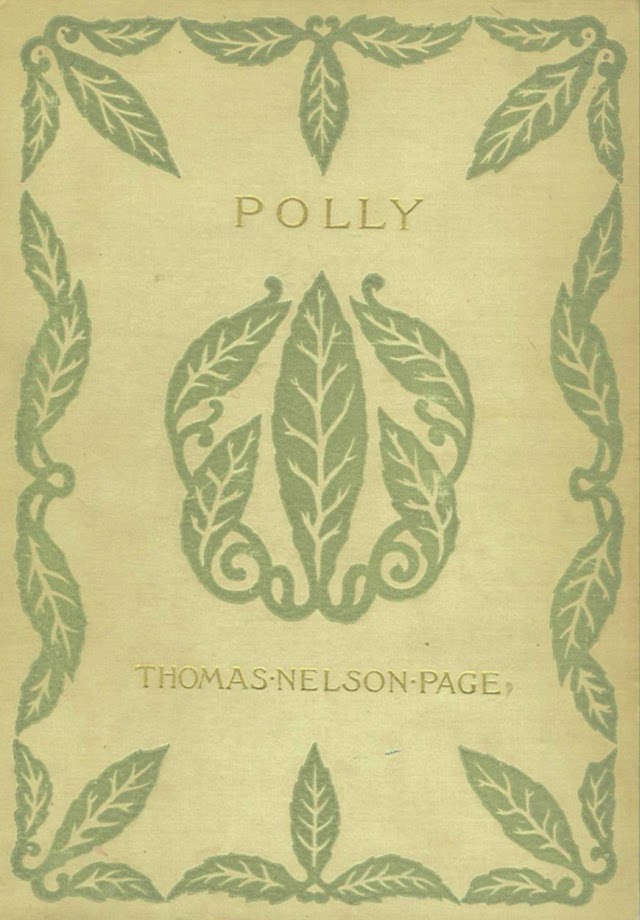
Polly
The Book Buyer (Vol. 11, February 1894-January 1895, p. 561) credits Alice C. Morse with the design of this cover for Polly: A Christmas Recollection (Scribners, 1894). Polly is one of a four-title set of books by Thomas Nelson Page. The first title in the set is Marse Chan, published in 1892. It is also unsigned but attributed to Morse. Morse's own book-cover for Marse Chan is in the collection of The Metropolitan Museum of Art (Accession number 56.522.79; See Dubansky entry 92-12.)
To see the Museum's Marse Chan, click on:
http://www.metmuseum.org/collections/search-the-collections/385894
The other titles in this set are Meh Lady (1894) and Unc' Edinburgh (1895). These have not been attributed to Morse.
A Bow of Orange Ribbon - A Newly Attributed Design by Morse?
There are numerous book cover designs for A Bow of Orange Ribbon by Amelia Barr in the 1890s and Morse may have designed one or more of them. Although this cover is not signed, I always thought that Morse may have designed it. This is only one of the many variants I have seen it in. Upon browsing my notes from the Cooper Hewitt Morse collection, I notitced this small sketch on the back of another design. Could it be an early sketch for this pubhsiled design. It certainly looks like it. Note the crossed swords, the rough bow design and the type layout.
Examples of Morse's Cloth Specifications
In an interview with Gilson Willets entitled "The Designing of Book-Covers" (Art Interchange, November 1894, pp. 118-119) Morse describes that she presented her publishers with two or three rough sketches. Once the publsher had chosen a design, Morse prepared a finished colored drawing, specifying the colors of the design and book cloth. Two of Morse's drawings for book covers at the Cooper Hewitt Museum feature cloth specifications on the versos. They are for cloths made by the Bancroft and Holliston Mills.
A Sketch for 'My Study Fire' at the Cooper Hewitt Museum
This post relates to Dubansky entry 99-3 (p. 82), Morse's publsihed design for My Study Fire, by Hamilton W. Mabie, published by Dodd, Mead & Co. in 1899. This sketch, a gouache painting, is one of Morse's original works in the Cooper Hewitt Museum. (Accession number 1943-33-1-9. Dimensions: 20.7 x 13.2 cm.) This design is a rare example of Morse's drawings at Cooper Hewitt that feature a book title. That is one of the reasons why I believe that it may be a design that Morse presented to her publisher for the cover of this book -- probably along with a drawing for the cover that was published. The published cover is quite similar. It features a cartouche much like this one, set into a rectangular panel design. Morse stated in an Art Interchange interview that she regularly presented two rough sketches to her publisher. I have not seen the original sketch for the published cover.
![]() |
| Morse's book-cover design as published |
Design in Poker-Work, A Footstool
Now that so many American periodicals are online, it's much easier to find Morse designs than it was when I was working on my book. This dynamic design, by Alice C. Morse, appeared in Harper's Bazaar on April 24, 1897 on page 348. It is included in the Proquest database. The design is for a pyrography footstool.
Tuesday, April 23, 2013
'Crown of Straw'; Is 'Majesty of Man' a Series Binding?
Thanks go to Richard Minsky and John Lehner who both let me know about this Morse-designed cover for Allen Upward's Crown of Straw (Dodd Mead, 1896). It is the same cover for Alien's Majesty of Man, also Dodd Mead, 1896. So, it is probably a series binding (if two constitutes a series -- or set?) but more homework is required. Below is a photograph of Alice C. Morse's own cover for this book that she left to the Museum in 1924. Link to MMA catalog record. I admire this design so much that you may have noticed that I used it for the cover of my book on Morse, only in red. Notice how there is a problem with the green stamping on the reverse diagonal-rib bookcloth.A clue to the fact that this may have been a series cover is that the lettering is not hand done, but stamped from type.
Monday, April 8, 2013
Original Cover Design for The Bookmaker, by Alice C. Morse
January 1891, page 15.
Link to image and article
http://books.google.com/books?id=dILnAAAAMAAJ&pg=PA15&lpg=PA15&dq=alice+c.+morse+american+bookmaker+January+1891&source=bl&ots=YzQrp4WYGa&sig=SUIyAqaF1SPOwUw3svWwrecouqA&hl=en&sa=X&ei=_EFjUY-vBeiZ0QH18oGQDQ&ved=0CDkQ6AEwAQ#v=onepage&q=alice%20c.%20morse%20american%20bookmaker%20January%201891&f=false
Subscribe to:
Posts (Atom)


