Monday, January 13, 2014

A Puritan's Wife - Everything Now Makes Sense


Max Pemberton
A Puritan's Wife
New York: Dodd Mead & Co., 1896
Printer: University Press: John Wilson and Son, Cambridge, U.S.A.
Signed AM, under the blossom below the title on the front cover
Dimensions: 18.2 x 12.7 x 2.5 cm.


The binding for A Purtian's Wife (Dubansky entry 01-1), never made sense to me. I found two adaptations, but never the original cover. Recently, Richard Minsky sent me a photograph of it, but thankfully, I've just found a copy for my Morse collection. For more information see the previous post on this title.

Bound in golden-tan linen finish plain-weave cloth, possibly a reverse cloth. It is stamped in olive green and a dull red, with gold lettering. The endleaves are plain off-white laid paper. Top edge gilt, foredge and tail are untrimmed.


House and Home Illustrated


Morse’s book cover design for Stevenson’s Ballads was featured in two nearly identical woman’s guides, published by Scribner’s in 1894-1896. Both include chapters on occupations for women, principles of housekeeping, the art of travel, house building and decoration, and books and reading. The Woman's Book and its successor, seen here, The House and Home, introduced Morse as an excellent example of the successful woman designer. In P. G. Hubert Jr.’s chapter titled “Occupations for Women,” the field of book-cover design was recommended as a viable occupation for women. The author buttressed his point by printing color illustrations of two woman-produced book covers: Morse’s Stevenson’s Ballads (Dubansky, 90-8); and Songs About Life, Love and Death, designed by Margaret Armstrong.


The House and Home. A Practical Book (in 2 volumes)
Multiple authors (beginning with Dr. Lyman Abbot)
New York: Charles Scribner's Sons
1894-1896

The binding for The House and Home is an adaptation of The Woman's Book. In this cover, the border and probably some of the spine motifs are Morse's design. To see the design as originally intended and read more about this entry click here.

Buy a copy of The Proper Decoration of Book Covers: The Life and Work of Alice C. Morse
http://alicemorse.blogspot.com/p/buy-book.html

Monday, November 18, 2013

Morse's Window for Carnegie Hall


Notation on recto: Over Main Entrance - Music Hall (5 of these)
Cooper-Hewiit Museum, accession number 2009-6-2

As mentioned earlier in this blog, the Cooper-Hewitt Museum posesses a substantial collecton of original designs for book covers and stained glass windows by Alice C. Morse. As you may already know from reading this blog or my book, Morse was a stained glass designer before she designed book covers and she was one of the original 'Tiffany Girls', working for the Tiffany Glass Company from 1885-1889. From the addresses on the versos of the designs, it appears that Morse continued designing windows after leaving Tiffany. Morse felt that stained glass and book-cover design presented similar challenges and were akin to each other from a design standpoint.

Alice C. Morse originally donated these drawings in 1943 to the Cooper Union Museum for the Arts of Decoration. Among the stained glass designs are eight drawings of windows commissioned for Carnegie Hall, or the Music Hall, as it was origianlly named. Morse's notations on the drawings indicate the location and quantity for each window as well as her name and address, which assist us in dating the designs. To my knowledge, these designs have not been published, but they should be available through the Cooper-Hewitt website -- if not now, at some point. While they have not been published, Jacquellann Killian of the Cooper-Hewitt Museum has conducted original research on Morse's window designs and has presented a paper entitled The Stained Glass Designs of Alice Cordelia Morse.

Friday, October 25, 2013

Scenes from the Life of Christ in a 'New' Color Variant


Jessica Cone. Scenes from the Life of Christ Pictured in Holy Word and Sacred Art. New York and London: G. P. Putnam's Sons, 1892.

Scenes from the Life of Christ is one of Morse's least seen designs from my point of view. It's a beautiful gift book, origianlly stamped in gold on off-white or tan bookcloth. Before the age of the Internet, it took me many years to find any copy of this book. I was recently suprised to see this copy on Ebay, and despite it's rough condition, I purchased it. The dark blue stamping on this color variant clearly shows Morse's drawing acumen. The pages of this book have black, decorative borders that may have also been designed by Morse, but that is unproven at this time. She isn't mentioned on the title page. This book is described in The Proper Decoration of Book Covers: The Work and Life of Alice C. Morse, entry 92-7, pages 61-62.

Found, Yet Lost - An Adaptation of the Design from the Portia Series


E. P. Roe. Found, Yet Lost. New York: Dodd, Mead & Company, n.d.

This adaptation of Alice C. Morse's design has recently been identified on the front cover of Found, Yet Lost . The original use of this plate was on the Portia Series, a five-volume series of self-help books for women, published by Dodd, Mead in 1891-1892 . Even within the Portia Series, several variants of Mores's design were used.  A detailed description of the binding variants for Dodd Mead's Portia Series can be read in The Proper Decoration of Book Covers: The Life and Work of Alice C. Morse, entry 91-2, p. 54.

Wednesday, October 16, 2013

Custom Book Blankies - Treat Your Books Like Babies


I thought I'd take this opportunity to let blog readers know about a product I've designed and have been using with great success. If you are collecting or conserving 19th century publishers' bindings, such as those designed by Alice C. Morse -- or any rare or fragile book, you will want to protect them by using book cradles and supports. Safe book handling procecedures are neccessary for the long life of books. At the Metropolitan Museum of Art, I have developed several styles of custom book supports and book weights that assist the reader and ensure that books can be safely read and displayed. As a conservator, I also use these to support books when I'm working on them.The supports I make are unique. I make two designs -- one design fits commercially available acrylic or foam book cradles and the other deisgn are a pair of long blankets that are used on their own, without cradles. Please see the Purchase Custom Book Supports page on this blog for details. If you have questions, or are interested in having these made for your collection, conservation lab or home library, please contact me at mindelldubansky@gmail.com.  

Tuesday, September 17, 2013

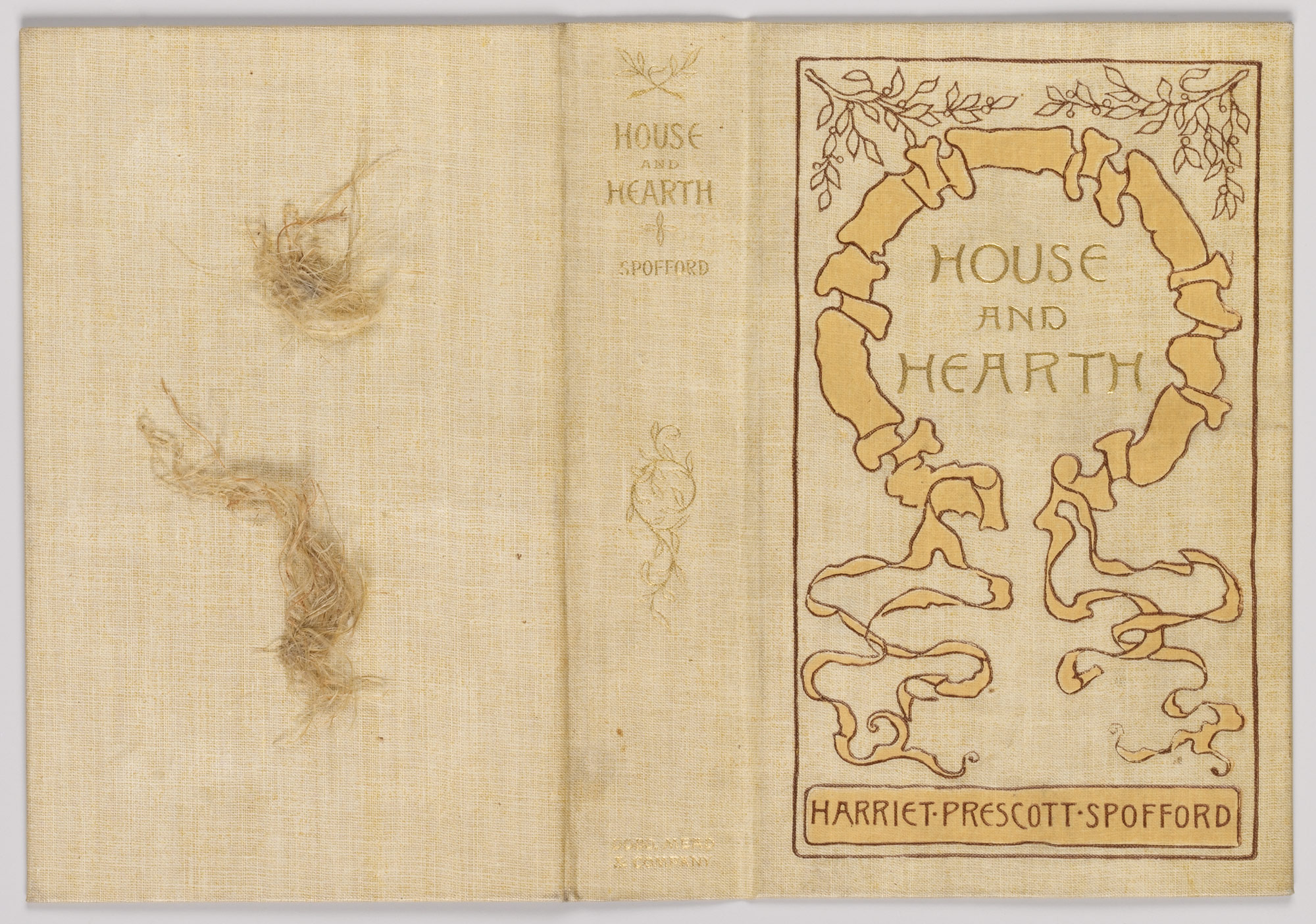
"House and Hearth" Design Re-used


Recently, I found two books with Morse's designs re-used on books published by Dodd Mead. Both of them were authored by E. P. Roe. The one shown below is A Brave Little Quakeress (1892), featuring a design originally created for House and Hearth (1891). The picture below is Alice Morse's exhibition cover that is in the collection of The Metropolitan Museum of Art (Deptarment of Drawings and Prints). To read more about Morse's book covers in on The Metropolitan Museum website, click here. The other book will be the subject of another post. This design is described in entry 91-3, Dubansky book.


Book cover for House and Hearth, 1891
Designer: Alice C. Morse (American, 1863–1961); author: Harriet Elizabeth Prescott Spofford (American, 1835–1921); publisher: Dodd, Mead & Company, New York
Beige cloth covered boards with light and dark brown and gold decoration
Overall 6 3/8 x 9 3/16 in. (16.2 x 23.4 cm), front cover 6 3/8 x 4 in. (16.2 x 10.1 cm), front cover and spine 6 3/8 x 5 1/4 in. (16.2 x 13.4 cm)
Gift of Alice C. Morse, 1923, transferred from the Library (56.522.50)

Here is the adaptation of Morse's design on A Brave Little Quakeress, by E. P. Roe, Dodd Mead, 1892. The color in this Ebay photograph is off. A more acurate photo may be forthcoming. The cloth is gold and the stamping orange-red. This design adaptation is not in the Dubansky book.